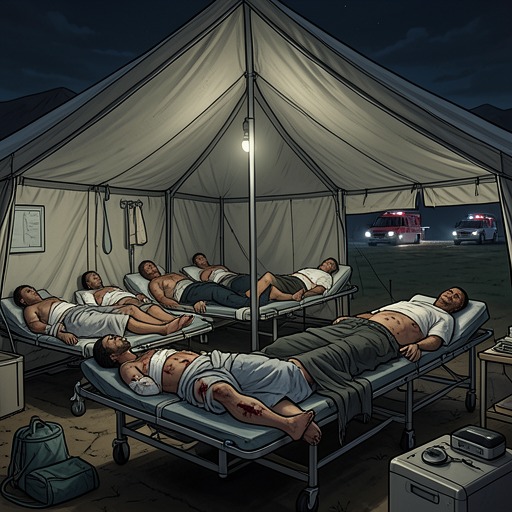
New York ventilator allocation protocol
Five Days at MemorialDevelopment and Purpose
The protocol emerged from planning for a severe influenza pandemic, not from ordinary hospital practice. During exercises involving H5N1 avian influenza, New York health officials repeatedly confronted scenarios in which hospitals ran out of ventilators. The New York State Task Force on Life and the Law was asked to address the problem. Planners first considered ways to stretch existing capacity, including canceling elective surgery, and the state bought and stockpiled additional ventilators. Those measures could help in a moderate pandemic but would fall far short of the need in an outbreak on the scale of the 1918 influenza pandemic.
The practical limits of ventilator care made scarcity more than a matter of counting machines. Ventilators were expensive, required highly trained operators, and consumed oxygen, which could itself be limited during a disaster. The group therefore devised rationing guidance intended to save as many lives as possible within an ethical framework. The protocol marked a departure from the usual medical standard of trying to do everything possible for each individual patient. Planning criteria before a crisis was meant to keep frontline staff from having to invent rules while exhausted and under pressure, as staff at Memorial had during Hurricane Katrina.
The plan also reflected the influence of an earlier proposal from Ontario, Canada, developed in response to the severe acute respiratory syndrome outbreak. That proposal adapted the Sequential Organ Failure Assessment, or SOFA, score, a tool used to track the progress of intensive-care patients, to help guide decisions about access to ICU care. New York planners adopted the score despite important limits: it had not been designed to predict survival and had not been validated for assessing children. It supplied a usable measure in the absence of a suitable alternative, not a perfect forecast of who would live.
Allocation and Withdrawal Rules
Under the protocol, patients with the highest severity scores could be denied access to scarce ventilators. It also identified serious chronic conditions that could count against allocation, including kidney failure, cancers that had spread and carried a poor prognosis, and severe, irreversible neurological conditions likely to be fatal. These criteria translated an aggregate aim—saving as many lives as possible—into decisions affecting particular patients whose conditions might otherwise merit intensive treatment.
The protocol went beyond deciding who would receive a ventilator at the outset. It provided for a trial period after which patients who were not improving could be removed from ventilators, with or without permission from their families. New York officials examined possible legal grounds for suspending a state law that prohibited doctors from withdrawing life support without express consent from the patient or an authorized health agent. Thus the plan contemplated not only allocating a limited resource but also changing the legal conditions under which ongoing treatment could be stopped.
That feature made advance planning consequential in a distinct way. A protocol prepared for a hypothetical emergency could, if formally activated, alter the rules governing care and the authority of clinicians. The book notes that other states had prepared emergency executive orders that could allow hospitals to turn away patients, protect doctors limiting care, and authorize measures such as drug seizure and quarantine. New York’s ventilator plan belonged to this broader effort to define, before catastrophe, what institutions might be permitted to do when normal standards and available resources could no longer be reconciled.
Katrina as a Point of Reference
The protocol was developed for a possible pandemic, but the book places it in the aftermath of the decisions made during Hurricane Katrina. At Memorial, the crisis forced staff to confront severe scarcity without a comparable prearranged allocation framework. The New York planners’ goal was to avoid putting frontline professionals in precisely that position: making high-stakes choices among patients while a disaster was unfolding and without agreed criteria.
The relationship between the protocol and the Memorial case is therefore one of influence and contrast, not identity. The protocol did not govern the earlier Memorial decisions. Instead, the arrests of health professionals in that case, and fears that a severe influenza outbreak could again force life-and-death choices, helped prompt attention to advance planning. The later framework attempted to make rationing explicit, structured, and reviewable rather than leaving it to improvised judgments in the immediate emergency.
Use During Hurricane Sandy
Years later, as Hurricane Sandy approached Bellevue Hospital, critical-care medical director Laura Evans faced a related problem. Hospital leaders believed a generator in a neighboring building might continue to function, but it could power only six ICU outlets. Fifty-six patients needed consideration. Evans had studied New York’s ventilator-allocation guidance and voluntarily repurposed its scoring approach to help decide which patients should receive access to the limited power. The pandemic plan had not been designed for this precise circumstance, so its use was an adaptation rather than a straightforward application of its original purpose.
Evans convened an ad hoc committee rather than making the choices alone. Its members included doctors, nurses, and ethicists, but not the patients being considered or their family representatives. The committee was composed of professionals who were not directly responsible for treating those patients, leaving individual clinicians freer to advocate for their own patients while the group considered the wider allocation problem. Evans explained that distinction to hospital leaders: the treating doctor’s role was to advocate, while the committee could compare patients using common criteria.
The committee’s decisions and reasons were communicated to other staff members. Some colleagues challenged particular choices, but accepted them, and the list was completed in about two hours, with patients moved between beds and outlets. Evans wanted a process that could be explained, applied consistently, and defended as fairly and equitably as possible. She knew that decisions made under emergency conditions could later be examined by the public, and she hoped to preserve trust by being able to account for how the criteria had been used.
Limits and Significance
The protocol’s use at Bellevue shows both the value and the limits of advance guidance. It gave Evans a procedure when the immediate question was stark—six outlets for fifty-six patients—but the underlying scoring tool was acknowledged to be imperfect, and the pandemic rules had to be adapted to a different emergency. A defined process could make the reasoning visible and distribute responsibility, but it could not eliminate uncertainty about prognosis or the moral weight of denying treatment.
Nor did procedural inclusion extend to patients and families: although the committee included several professional perspectives, it did not include representatives of those whose access to power was being decided. The plan’s central tension thus persisted even when decision-making was organized. Advance criteria may protect clinicians from having to improvise alone and may support consistent treatment, but they also formalize exclusions and can carry legal consequences. In the book’s account, the protocol is not a final answer to disaster rationing; it is an attempt to make unavoidable choices less ad hoc, while exposing how much remains unsettled when scarce equipment becomes a condition of survival.